
What if your access to health care wasn’t tied to your job, your partner or your age?
That’s a future Dr. Tammy Carpenter asked Oregonians to imagine during a statewide Universal Healthcare Tour in September. She partnered with HCAO Action to talk about Oregon’s universal health care proposal, and to ask Oregonians what they want to see in the final plan.
The eight-stop tour covered Bend, La Grande, The Dalles, Salem, Medford, Coos Bay, Newport and Astoria.
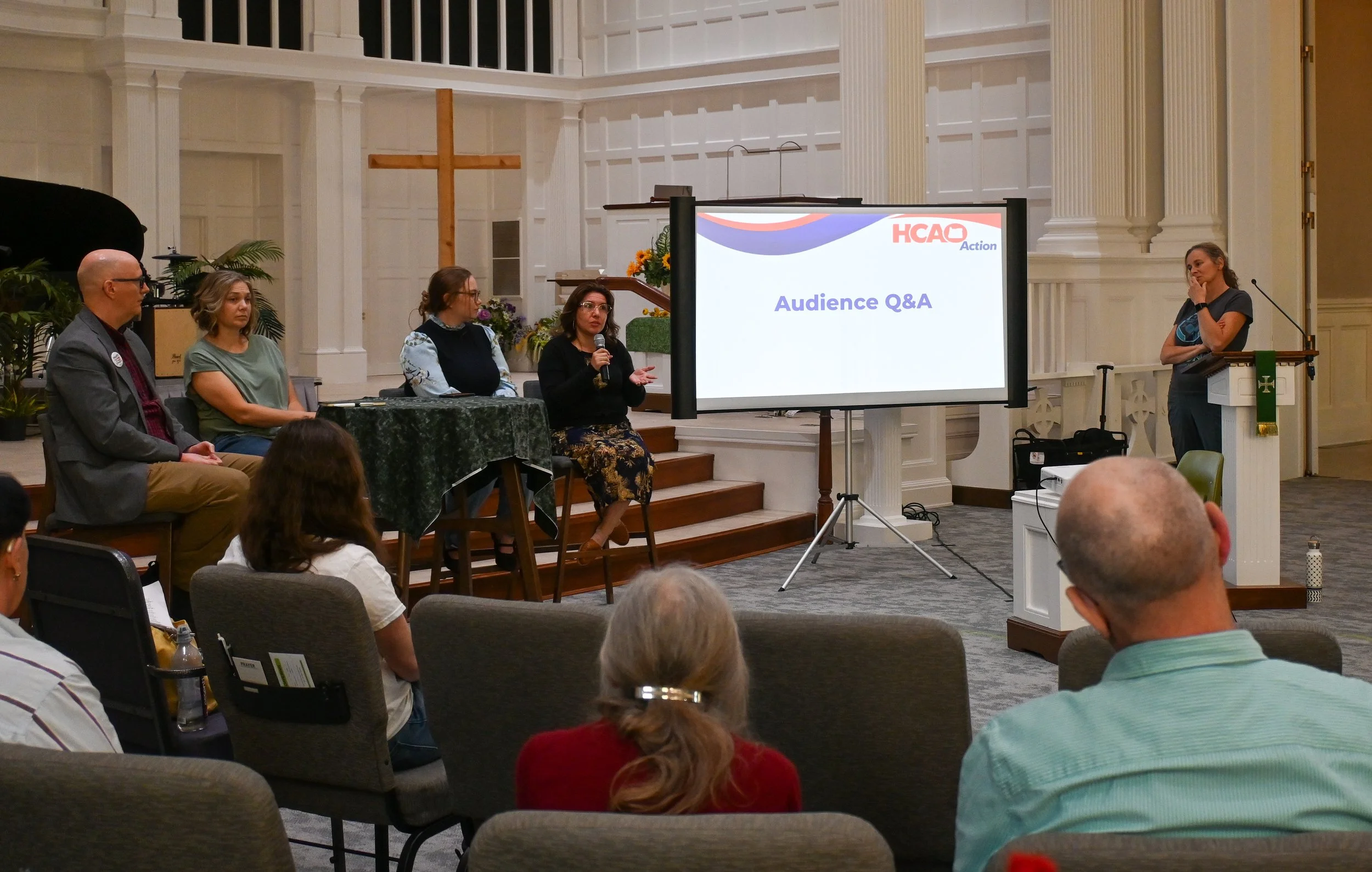
In Salem, Carpenter was joined by State Rep. Lesly Muñoz, Dr. Trevor Phillips, State Senate candidate Virginia Stapleton and Health Care for All Oregon treasurer Anna Thom. The panel spoke with a gathering of about 13 community members, who asked questions about the proposal and expressed concerns about the current healthcare system.
The Universal Health Plan Governance Board, an independent body created by the Oregon Legislature in 2023, is designing universal health care plan. It is separate from HCAO, and reports to the Oregon Legislature.
The UHPGB “is going to try really hard to make sure that this cost is going to be very progressive, so that, you know, ordinary Oregonians are not going to be more than they're paying right now,” Carpenter said. “And no co-pays, no deductibles, no out of pocket costs.”
Each of the panelists in Salem brought their personal and professional experiences with the current healthcare system to the discussion.
Carpenter, an anesthesiologist, knows the frustrations as a patient and a provider.
“It’s going to be so simple for patients,” she said. “You walk in, you see the doctor, you walk out. You don't take out your checkbook, you don't take out your credit card. As a provider, as a physician, I don't have to worry about the insurance company denying the claim.”
Health care will cost less, she said, “because we are taking out the middleman.”
Under the proposed plan, no provider will be out of network and administrative costs will be lower.
Carpenter said they’re envisioning a nonprofit corporation for universal healthcare, similar to SAIF, a not-for-profit workers' compensation insurance company.
Rep. Muñoz is on the House Interim Committee on Health Care.
“For the last 2 years, I have seen how our healthcare system doesn't work,” Muñoz said.
She’s concerned about the increasing difficulties that vulnerable populations will face in the next couple of years to access health care.
“It costs the state money whether you have insurance or not,” she said. “In fact, it costs the state more money if you wait and go to the emergency room.”
Another benefit of universal healthcare, she said, is that it will leave more money on the table for increasing wages when it comes to bargaining for contracts.
Thom was inspired to volunteer for HCAO by her father, who was a first responder for 20 years.
“He served on the Warm Springs reservation and due to his job, being a firefighter/EMT, he got early onset Alzheimer's,” Thom said. “So, he served our community and our state for 20 years, and now he's in a situation where he has no health care. And he's very, very vulnerable, and so that kind of got me off the couch and got me volunteering and really put the target on how we need to have universal healthcare in our state. And hopefully the whole country.”
Stapleton said she thinks about access to care, the time she’s spent trying to find doctors that accept her family’s insurance and that have openings.
“I think about my own personal story,” Stapleton said. “I've got two kiddos, one of which is sick quite often. This year, we paid $14,000 out of pocket for the care that they needed. I know that my kids are not the only ones that are suffering, and I want to make sure that we have just the base level of care provided by our government, for our citizens, and for anybody visiting our country.”
Phillips, an emergency room doctor at Salem Hospital and former Salem city councilor, said one of his fondest memories of serving on council was being encouraged by HCAO to present a resolution declaring health care as a human right.
“I was thrilled, when that resolution passed unanimously,” he said. “I was also shocked…but that just shows you, this affects everybody. Everybody at some point will go through the emergency room directly or indirectly. And I can tell you, it doesn't care if you're a trillionaire or if you have no money at all. And healthcare absolutely has to be a fundamental human right, and we do live in a country where more than 50% of bankruptcies are due to medical bankruptcies.”
Carpenter pointed out that Canada’s universal healthcare system started with one province and eventually was established nationwide. She hopes Oregon can do the same in the United States.
The goal is to deliver the plan to the Oregon Senate in December, resulting in a bill.
“What advocates are hoping for, what legislators are hoping for, is that we will then pass that bill, and then it will show up on the ballot for Oregonians to vote on in November of 2028,” Carpenter said.
If it passes in November of 2028, a four-year implementation period is anticipated, she added.
Attendees at the Salem event shared concerns about the amount of money insurance companies will spend to defeat the bill, how it will interact with Medicare and the potential for the system initially being overwhelmed.
HCAO is partnering with other organizations, including unions, and has a committee dedicated to marketing the plan and meeting community members where they are.
“I know that this is going to be a fight,” Muñoz said. “I know that these folks have deep pockets because I can see who they contribute to and we're going to have to fight those people. But I think that we should be ready to say, ‘If you don't get on board with the job that people elected you to do, you will be primaried.’”
Since Medicare is a federal program, those dollars won’t be disrupted, Carpenter said.
“We can't interrupt the federal dollars,” she said. “When you go to the doctor, the physician will submit the bills to Medicare being paid through Medicare, and anything that's additional…that's where the universal health plan makes up the rest.”
Some people have expressed a fear that doctors will leave the state if it adopts a universal healthcare system.
“If you'd asked me three or four years ago, before private equity started buying up anesthesia practices, I would have said that they would probably never want to do this,” Carpenter said. “We experienced that in Portland, a very long standing 36-year practice that had a relationship with the hospital system for 36 years. They said, ‘Oh, we're going to bring this private equity group. Bye.’ So we, as physicians, are learning our class position.”
Muñoz, who represents Woodburn, said there is a pipeline for Woodburn High School students to work at the large Amazon warehouse. She suggested creating a pipeline to guide students to medical school.
“I do think there's going to be a lot of really important story sharing, one-on-one that's going to help get this passed,” Carpenter said. “I do want to echo Rep. Muñoz, that the other side is going to be organized and have a lot of money. And I think this side is growing more organized every day, and there's a coalition.”
